
Technology is ever evolving and so are the multimedia communication tools available to marketers. Which medium is going to be the next big thing?
In order to efficiently leverage the power of new technology, marketers need to understand the strengths and weakness of the mediums. As with all change, not everyone is an early adapter. In order to reach trendsetters and laggards alike, classic marketing and social media marketing need to integrate the strengths and weaknesses of their various aspects to create a solid team.
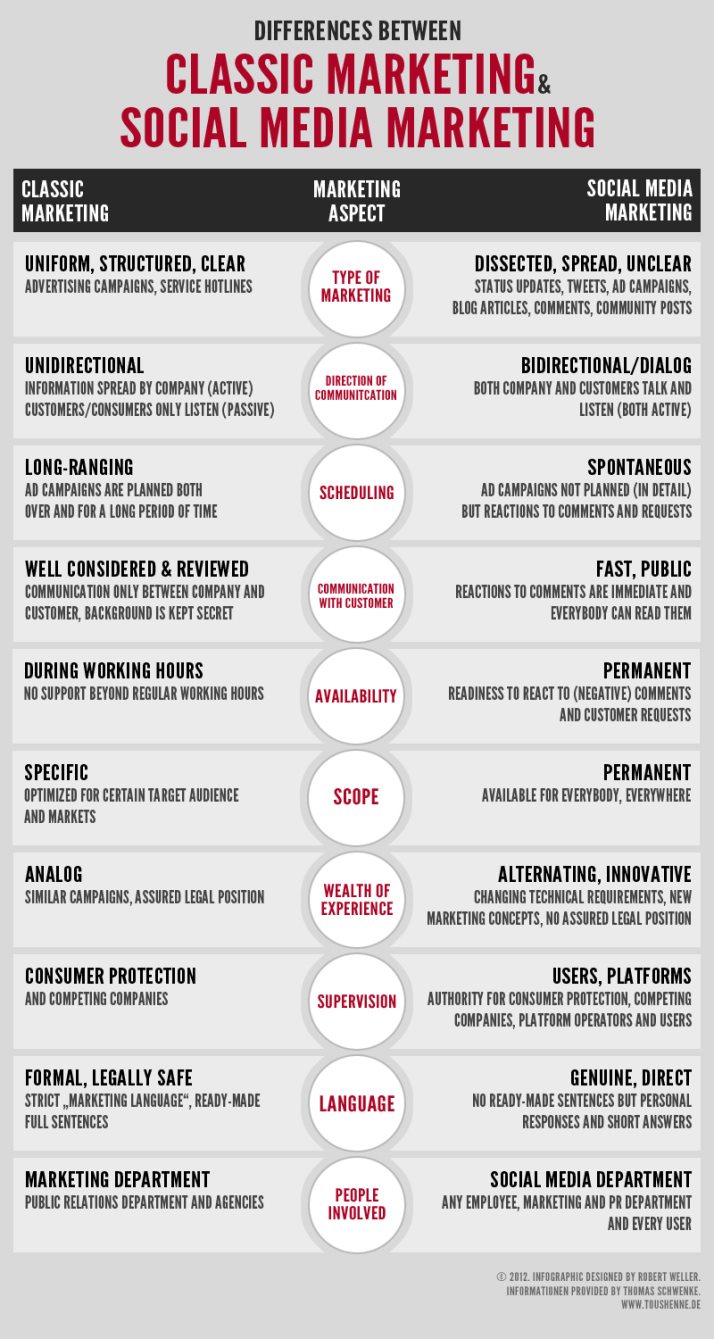
Let’s take a look at two of those aspects, communication with the customer and availability.
Communication with the Customer
According to the above infographic, classic marketing used “well considered and reviewed” materials to deliver their message to their potential customer. Brand messages were crafted in board rooms, weeks in advance. Whatever message you were going to put on the billboard on the side of the highway was going to stay there for months.
Once the classic marketing created a sale, there would sometimes be dissatisfied customers. Complaint letters would be delivered by mail carrier, days after the customer service breakdown. By the time the company actually answered the customer’s letter, the customer may have already taken their business elsewhere.
With social media, the marketing is “fast and public”. Whether you address a concern, or not, is no longer shrouded in the secrecy of an envelope. Both the complaint and the resolution is live on Twitter, Facebook, Instagram, Google, or an email chain. If social media is used correctly, customer complaints can be resolved before the dissatisfied customer reaches home. Social media, such as text messaging, email, search engines and twitter allow instantaneous responses, provided the channel is being monitored regularly.
Which way is best for your brand? Can your customers use the channels of communication you give them?
An integrated marketing communications plan may be the best way to go, to reach all potential consumers. If you receive a letter, return the letter. If your hashtag is used, re-Tweet it. Either way, the sender will feel like they matter, and they will not only come back, but also share with their friends. Facebook and Google have, according to Young, “reshaped mass communications globally and opened up opportunities for marketers to execute more accountable, influential, and multidimensional campaigns 1.” Billboards have become digital, newspapers are read on iPads, shopping magazines become webpages. Your message across platforms needs to be consistent, to take advantage of both classic marketing concepts and social media marketing mediums.
Availability
When did 9-5 become 24/7? Working 9 to 5 used to be the standard. Businesses had office hours that were Monday through Friday, 9am until 5pm. If you weren’t able to either call of visit the company during that time frame, your problem was not going to be resolved. A phone book could provide you with an address to write a letter requesting more information.
24/7 now better describes our current marketing environment. Even if a brand is not actively utilizing a form of communication, the uniform messages and logos they have created are being shared between friends and family.
Not only are customers looking for products and services at all hours of the day, but brands are providing employees and applications to satiate their cravings. Google, Facebook and Twitter are changing the way that brands connect with their consumers.
As discussed in this week’s lecture, Oreo didn’t take the classic passive Super Bowl advertising route. They were on hand during the game to take advantage of an advertising opportunity that was up to date, relevant and shareable. Their tweet disseminated during the broadcast is below.

But their relevant tweets didn’t stop at the end of the game. Visit their twitter page for more timely messages that incorporate national holidays, photos, videos and interactive hashtags. They are engaging their followers on a regular basis.
When looking at availability, as long as brands stick to their core message and stay up to date, the multitude of social media channels is a huge advantage. Social media contains accurate analytical programs to promote a two way conversation. One of Young’s techniques in his book, Brand Media Strategy, is to “let consumer insight drive the media strategy2.” By listening to the two way conversation generated by social media, new ideas on how to reach your audience are always available.
From a balance perspective, is always being available best? What happened to a work/life balance? If you are permanently ready to respond to each customer’s hastily tapped out tweet, are you ever relaxed enough to enjoy the fruits of your labor? Limiting responses to business hours may lead to happier employees. It has worked well for Chik-fil-a.
You are in charge of your own brand. Take a look at your resources and your goals. Observe how and when your customers are trying to communicate with you. Adjust your services accordingly, to anticipate and meet their needs.
Then be ready for the next big thing!

1. Brand Media Strategy: Integrated Communications Planning in the Digital Era, Antony Young, Chapter 1, page 1
2.Brand Media Strategy: Integrated Communications Planning in the Digital Era, Antony Young, Chapter 2, page 23
 schmidtbyamanda